
This proposal has been developed with the Citywide Council of Presidents, Neighbors Helping Neighbors, and Residents to Preserve Public Housing.
Addressing the fiscal needs of New York City’s public housing is attainable. This coalition has developed the following recommendations to do just that. Our solutions center on Comprehensive Modernization, a design build process that ensures tenants participate in the decisions surrounding the rehabilitation of their homes, while retaining the benefits and rights guaranteed by Section 9.
Our plan is simple. We demand that all monies allocated to NYCHA be earmarked for comprehensive modernization. These funds should be executed based on the physical needs of developments. A budget line item titled “Save Section 9” is funded via 5%- 10% of revenue created by identified sources at the city, state and federal level.
Background
Save Section 9 and Community Service Society independently reviewed NYCHA’s physical needs assessment and concluded that a majority of the increase between the 2017 and 2023 PNA stems from “market conditions and inflation”. NYCHA’s actual need is approximately $41.4B from 2023- 2043. This makes NYCHA’s annual need $2.07B. This total need can be addressed by strategic investments by the city, state and congress.
On average New York City allocates 5% of NYCHA’s operating budget, approximately $250M. However, the mayor’s preliminary budget allocates $662M to privatization via Project Based Section 8. We oppose his investment in privatization (via Project Based Section 8/ PACT) and support of demolition. We urge the City Council to shift the mayor’s preliminary allocation of $662M towards Section 9 public housing comprehensive modernization.
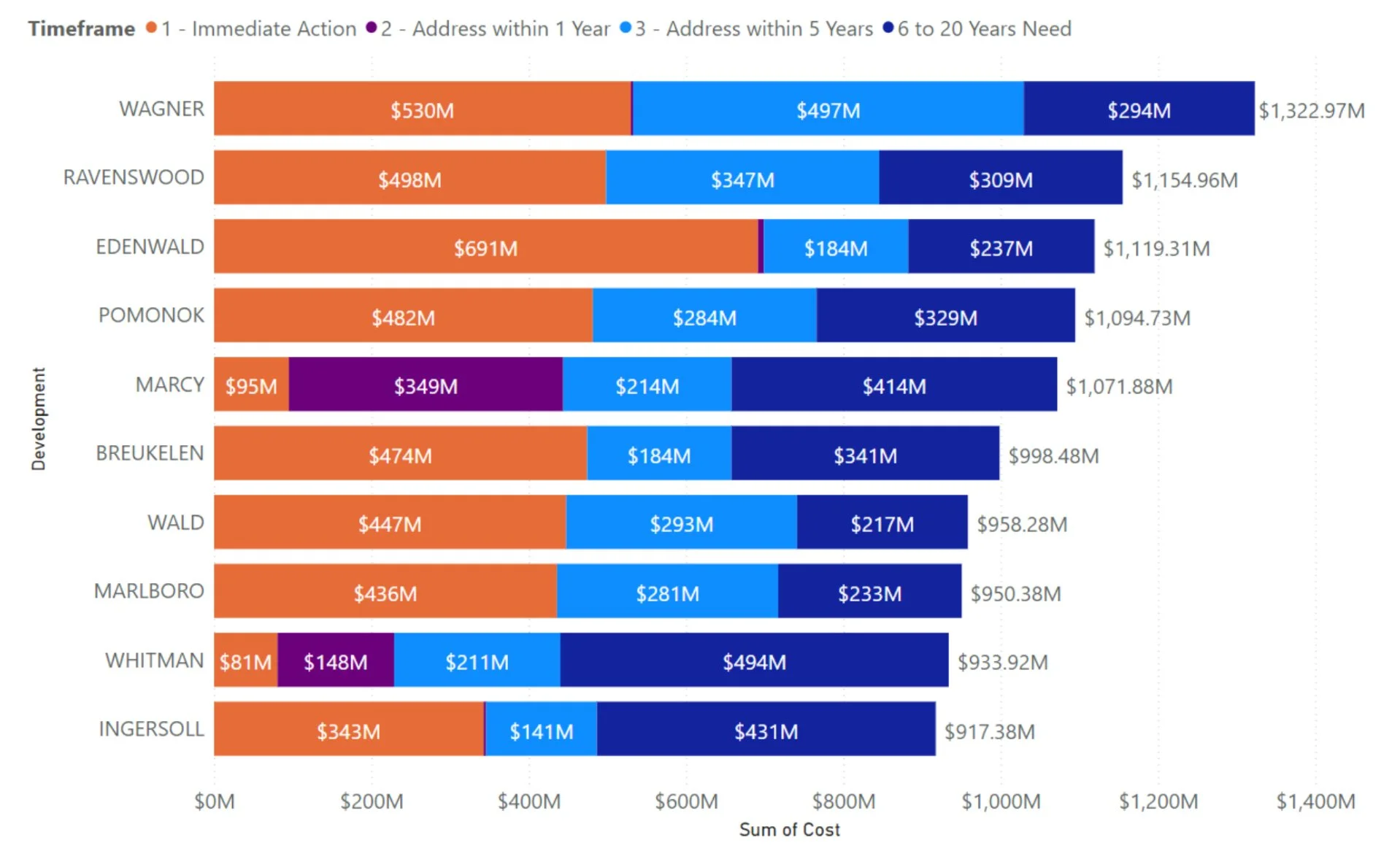
$662M could address the entire fiscal needs of Wagner Houses, the development in the worst shape according to NYCHA’s latest physical needs assessment. That’s 22 buildings, 2,162 homes for the next 100 years. Wagner has a need of $530M and 128 vacancies, and 16 non dwelling units. It is followed by Ravenswood Houses with 31 buildings, 2,166 units and a need of $498M, 65 vacancies, and 4 non dwelling units.
We support the Council’s call for additional investment from New York State and ask the governor and our state representatives to allocate $1 billion a year for NYCHA over the next four years. This funding should be earmarked for comprehensive modernization based on PNA findings. Additionally, Speaker Menin discovered $720m found to be unspent since 2021. This funding should be earmarked for comprehensive modernization.
Sustainable Revenue Sources
We urge the adoption of legislative proposals that increase the city and state’s revenue. The revenue created by these would fund a budget line item and ensure rehabilitation and expansion of Section 9 is fiscally sustainable.
In New York City 10% of the Fair Share Act would result in $400M annually for Section 9.
At the state level 5% of the Repeal of Stock Trade Tax (STT) Rebate Act would secure $3B for Section 9.
Nationally 5% of the Make Billionaires Pay Their Fair Share Act would create $22B for Section 9.
Solutions
Institute a moratorium on privatization via Project Based Section 8 (RAD/ PACT and the Public Housing Preservation Trust). NYCHA could use this time to assess their performance, recalibrate and refocus on their core responsibility, managing Section 9 in NYC. The moratorium should be reliant on an impact study being conducted by the Government Accountability Office as requested by Congresswoman Maxine Waters in 2023.
Establish a pathway back to Section 9. RAD/ PACT is fundamentally anti-democratic because it strips tenants, cities, states and Congress of policy flexibility. The lack of a return mechanism erodes public assets, and leads to permanent public-sector shrinkage without future voter consent.
Democratize the privatization process. Project-Based Section 8 transforms public housing governance without creating equivalent democratic protections for tenants. Tenants experience privatization as something done to them rather than governed with them.
Develop new guidelines for an organizational plan in tandem with the Federal Monitor. The last plan was fiercely denounced by tenants and adopted in spite of our objections. We recommend this plan be inspired by the operational plans of 1965-1970.
Encourage and support NYCHA’s growth. Ensure that hiring focuses on securing union personnel for roles that improve tenants’ quality of life. Each development should have a plumber, a carpenter, and enough building porters to assign two porters to each building. We would make plasterers and painters the second wave of hiring. These roles should provide apprenticeships to tenants and lean on Section 3.
In Solidarity,
Citywide Council of Presidents
Neighbors Helping Neighbors
Residents to Preserve Public Housing
Save Section 9